Site Observation – Tree Circumference
November 12th, 2018

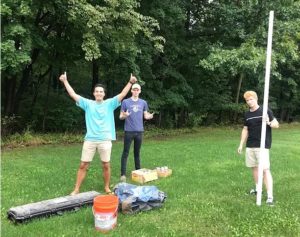
Now that we have chosen The Canopy Community as our optimal design, we can begin more specified research. As part of this research, we explored the site with a focus on identifying the minimum tree circumference we are willing to keep in the area of design. Anything under this minimum circumference including shrubbery and smaller trees would be cleared once the design is implemented. Trees at our above this circumference would stay on site and would become part of The Canopy Community. The optimal tree circumference was decided to be anything greater than 4 feet. Additional site observations will be necessary in the future as we approach the design portion of the project.
Final Design Decision
November 7th, 2018
After reviewing the design matrix and receiving feedback from our peers and professors, we decided to choose The Canopy Community as our optimal design. The Canopy Community is something that not many campuses have and could be a marketing tool for the college. A positive about this alternative is it is the most affordable because it will be constructed of timber. Another positive is it is the most environmentally friendly which is something that was a goal when selecting optimal design. The previous issue of designing around the wetlands will not be a problem since the canopy community will be elevated off the surface and the footing will not be placed in the wetlands. As a safety measure, our final design cannot be too high off the ground to reduce the risk of injury due to falling and must also be visible from Metzger Road. Using timber design, having trees grow around the platform, and placing lights surrounding the location will create an aesthetically pleasing environment for individuals. Our goal is to create a safe environment on campus that will offer a place of seclusion and relaxation away from the classroom.
Decision Matrix
After finalizing our three alternatives we decided to rate them based upon different constraints that include Attraction, Safety, Social, Space, Accessibility, Economics, Environmental, Weather, Geo technical, and Structural. We weighed all of these constraints based on which ones we thought was most important for our design, 3 being most important and 1 being least. Once we finished calculating these categories, the Canopy Community design came out on top with a score of 56, second place was the amphitheater with a score of 50, and last was the Rooftop Garden with a low score of 38. The matrix helped us organize our thoughts and going into the alternative presentation we hope we can get more feedback to finally pick our top design.
Further Testing, Soil Profile, and Properties
October 9-19th, 2018
In order to further compare the soil to the boring logs, additional auger tests were conducted around the lakes. In total, three auger tests were performed, each with varying depths recorded. Based on the soil samples we recovered, we found that it matched up with the boring log data. Knowing this, we were able to generate a soil profile with distinct properties for each strata. Three main strata layers were determined: a cohesive (primarily silt) layer at the top, followed by a granular (primarily sand) layer, and ending with bedrock (decomposed shale). The profile and properties will be used to design the foundation of our project.




Boring Log Comparison September 25, 2018
Using multiple boring logs the team was able to match soil properties from the auger site to those shown in boring logs from previous boring tests. A total of six boring locations from NJDOT and Langan Engineering were used to match soil properties. The soil samples from augering on September 18, 2018 are similar to the first 18 inches of all the collected boring logs.
NJDOT Boring Log B-3 NJDOT Boring Log B-2 NJDOT Boring Log B-1 NJDOT Boring Log P-2
Augering September 18, 2018
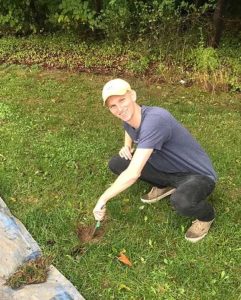
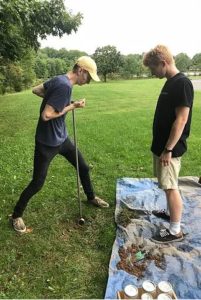
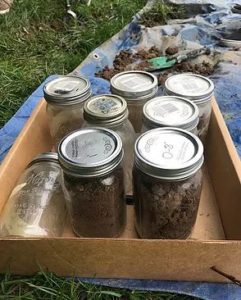
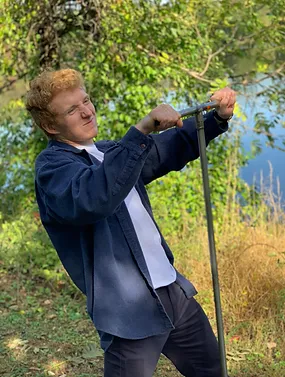
In order to verify the soil composition of our desired area of design, augering was performed. By comparing the field results with various boring logs recorded around our design site, we were able to confirm the soil composition. Despite digging after a rainstorm, the rocky soil only allowed us to auger about 18 inches into the ground. Although only few mason jars were filled, we were able to identify the soil properties.