Fall Semester Update
During the Fall semester, significant progress was made in data collection and site analysis. Several realistic design constraints were identified, such as protecting environmentally sensitive areas, including tree-lined sections and nearby wetlands, working within a limited right-of-way, navigating existing utilities, and accommodating high traffic volumes of approximately 18,000 vehicles per day along Washington Road and over 80,000 vehicles daily on U.S. Route 1. These conditions emphasize the corridor’s importance and the need for improved safety and traffic flow. Using this information, three alternative design solutions were developed to enhance multimodal accessibility, reduce congestion, and improve overall safety within the project area.
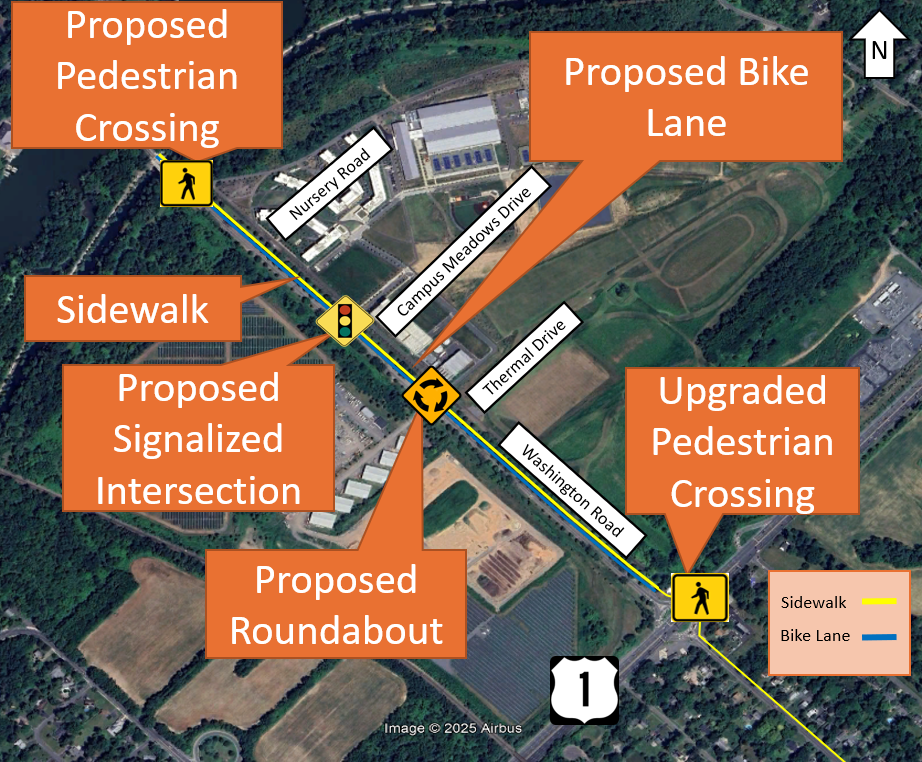
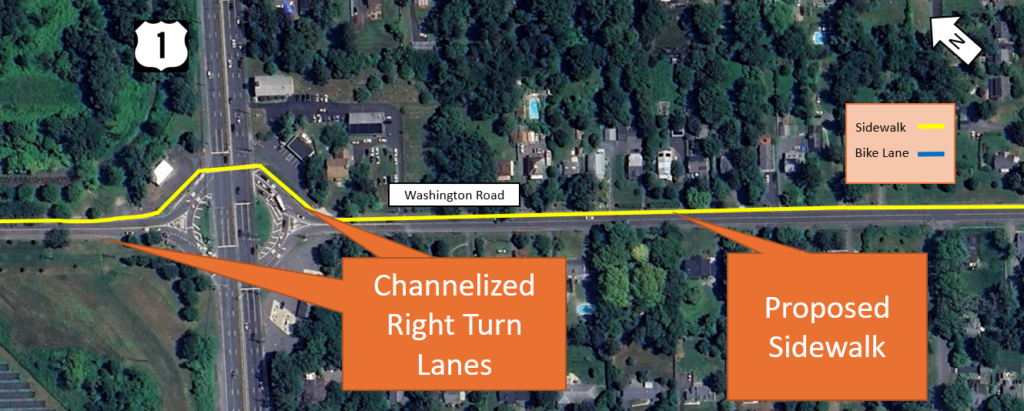
Alternative Design 1 proposes a pedestrian crossing at Nursery Road and Washington Road for safer pedestrian movement, along with a protected two-way bike lane on the northern side, connecting to existing bike lanes leading to Princeton University. The Campus Meadows Drive and Washington Road intersection will be redesigned as a signalized three-way intersection to improve traffic flow and safety. A roundabout at Thermal Drive and Washington Road will help reduce speeding by slowing traffic. Additional pedestrian crossings with Rectangular Rapid Flashing Beacons (RRFB) will be added east of Route 1 and north of the Route 1 intersection to enhance safety and connectivity. A median along Washington Road will prevent head-on collisions and improve pedestrian safety, while channelized right-turn lanes at the Route 1 intersection will reduce delay times and improve overall traffic flow.
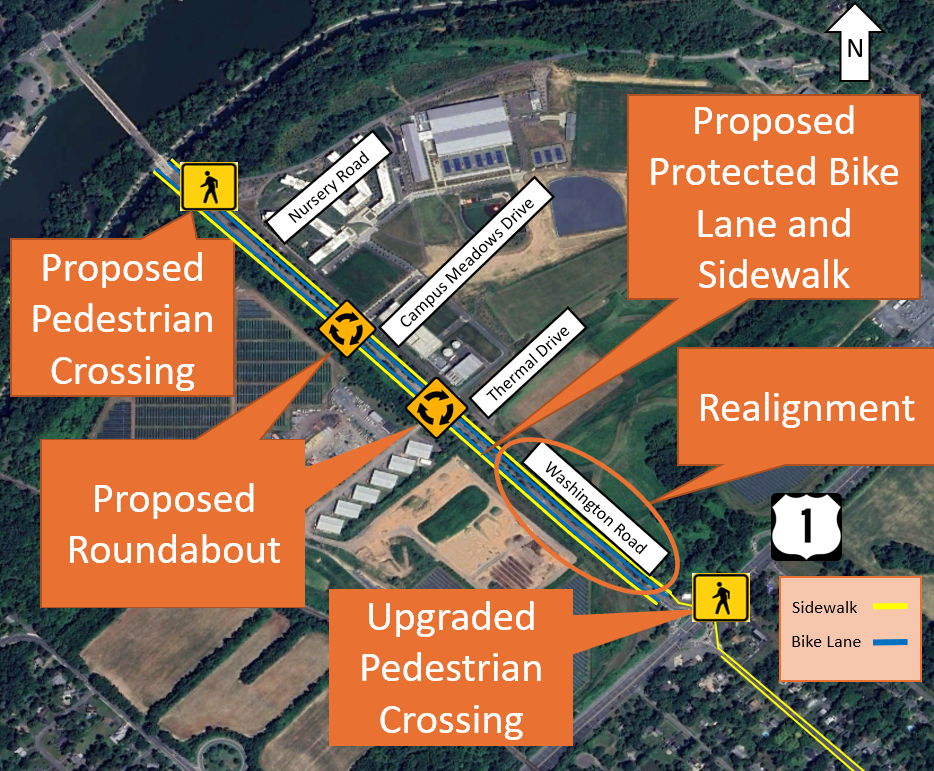
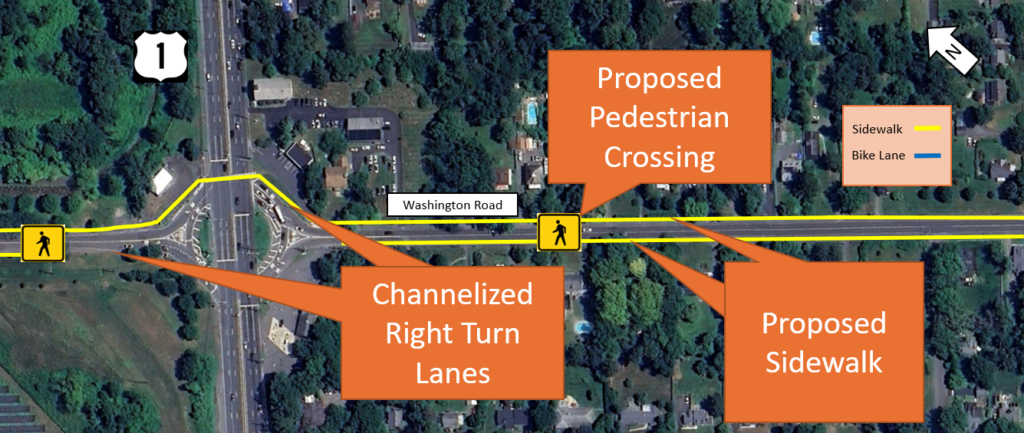
Alternative Design 2 proposes a pedestrian crossing at Nursery Road and Washington Road, similar to Alternative Design 1. It includes one-way protected bike lanes on both the north and south sides of Washington Road to ensure cyclist safety. The Campus Meadows Drive and Washington Road intersection will be redesigned as a three-way roundabout, while a four-way roundabout is proposed at Thermal Drive and Washington Road to control speeds. Between Thermal Drive and Route 1, Washington Road will be realigned with a median, bike lanes, and sidewalks on both sides to improve multimodal access. Another pedestrian crossing will be added east of Route 1 for better connectivity. At the Route 1 intersection, channelized right-turn lanes will be introduced to improve traffic flow and reduce delays.
Alternative Design 3 integrates the Faculty Road and Washington Road intersection to enhance connectivity between the proposed bike lanes and the existing campus network, redesigning it as a four-way roundabout to control vehicle speeds near the campus. On the Route 1 side, a pedestrian signal and crosswalk, similar to those in Alternative 1, will improve connectivity with the surrounding community. This section will feature a sidewalk and a two-way bike lane. Further along Washington Road, chicanes will be added to slow traffic, and at the Thermal Drive intersection, pedestrian signals and crosswalks will be introduced with sidewalks on both sides of the road. The Campus Meadows Drive intersection will be redesigned as a signalized three-way intersection, while Nursery Road will be repurposed exclusively for pedestrians and cyclists, with a safe crossing and bike lane transition. At the Route 1 intersection, channelized right-turn lanes will be added to improve traffic flow and reduce delays.
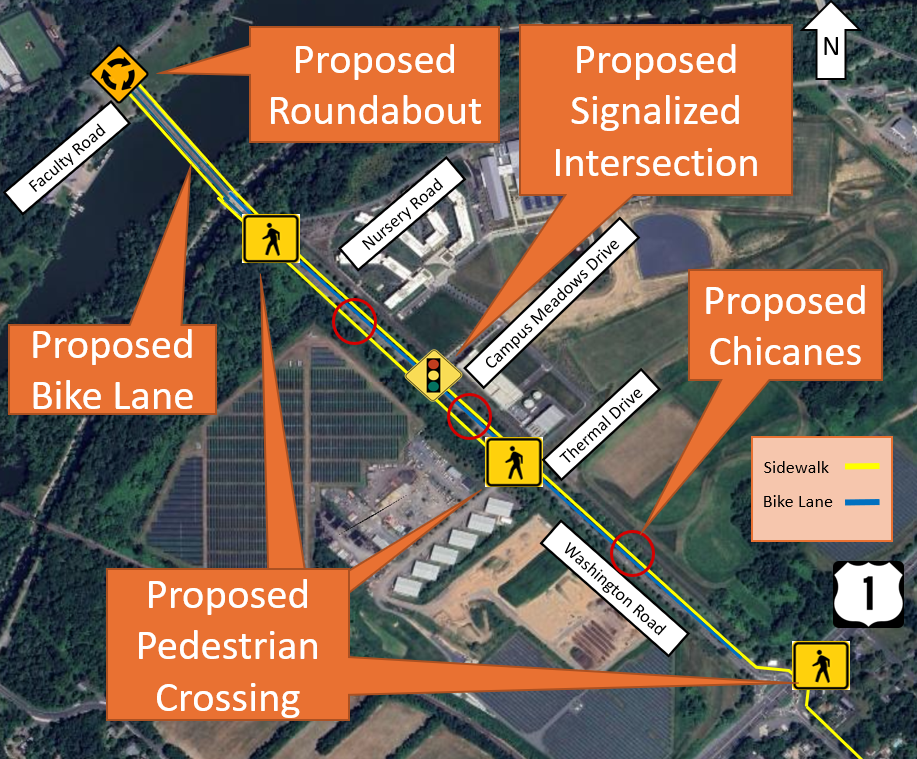
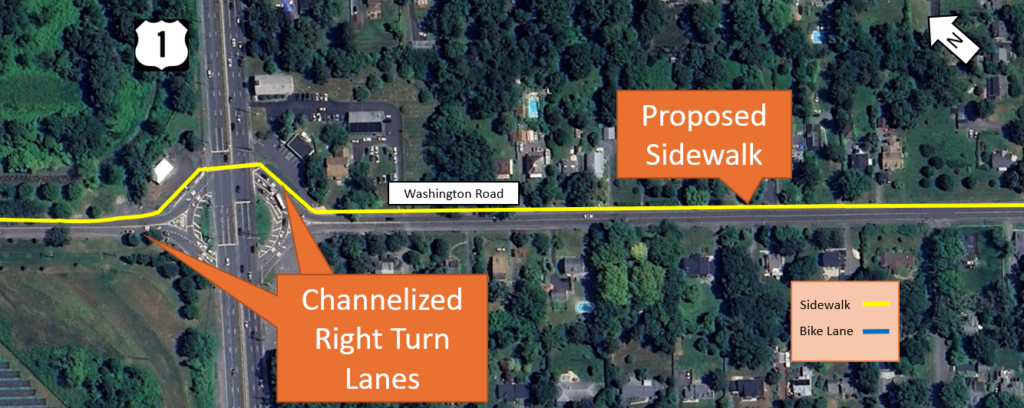
The team then created a selection matrix, where Alternative 3 was selected as the optimal solution for its balanced performance across all criteria. The final engineering design cost for the fall semester is $23,000, with an estimated $18,000 for the spring semester.
Below is a link to the Fall Semester Engineering Services Proposal Presentation