Explore the developments of our Chopart prosthesis design and stay updated on our progress through our project journey.
What is a Chopart Amputation?
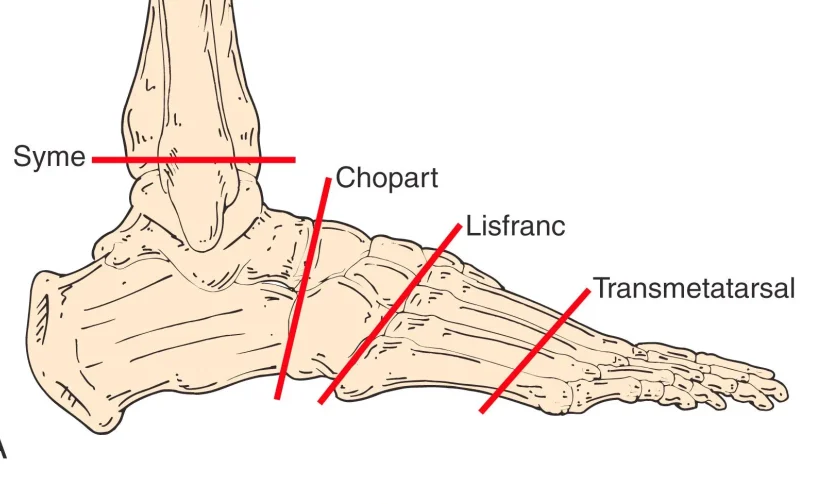
The user receiving the custom prosthesis is a Chopart amputee. Chopart amputations are performed at the midtarsal joint, between the talus/calcaneus and navicular/cuboid bones. This amputation is performed to preserve the heel and hindfoot, which serve as a weight bearing support.
(Crary Shoes, Portland, OH)
Project Objective
The objective of this project was to create a functional, manufacturable prosthesis for an individual with a Chopart-level amputation that enhances the performance, functionality, and comfort of the user’s current design.
Why?
The majority of prosthetic devices available for Chopart amputees restrict natural ankle mobility, leading to discomfort during daily activities such as walking and standing. It is difficult to perform daily tasks, such as sitting down, standing up, or walking down/up stairs.
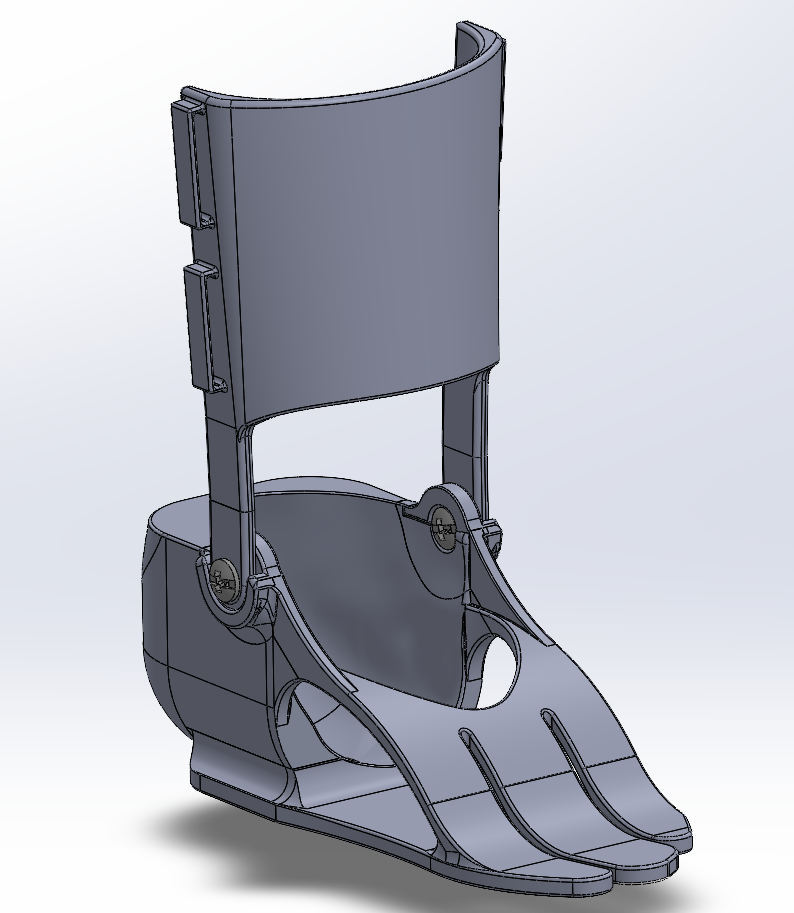
Final Prosthesis Design Created With CAD Software
(SolidWorks, Waltham, MA)
The proposed design incorporated a socket/baseplate structure and a proximal brace that are connected by a pin joint at the ankle, with one degree of freedom along the sagittal plane of the body. This joint allows 10 degrees of dorsiflexion and 20 degrees of plantarflexion due to the hard stops created on the exterior of the socket.
The interior of the socket replicated the subject’s residual-limb geometry, which was generated as a CAD model obtained through 3D scanning of the residual limb with the EinScan Pro 2X 3D Scanner (Shining 3D, Hangzhou, China).
The baseplate was designed to replicate the curve of a generic foot-rollover shape to generate momentum while walking.
The extrusion from the top of the socket to the ball of the foot of the baseplate was added to support and distribute the high pressures located at the ball of the foot when walking and standing.
The prosthesis design incorporated phalange-like sections that divided the baseplate’s forefoot into three independent segments. These three sections can move vertically relative to each other, allowing the baseplate to adjust to uneven terrain. This attempts to replicate the natural pronation and supination of the foot, helping prevent lateral instability.
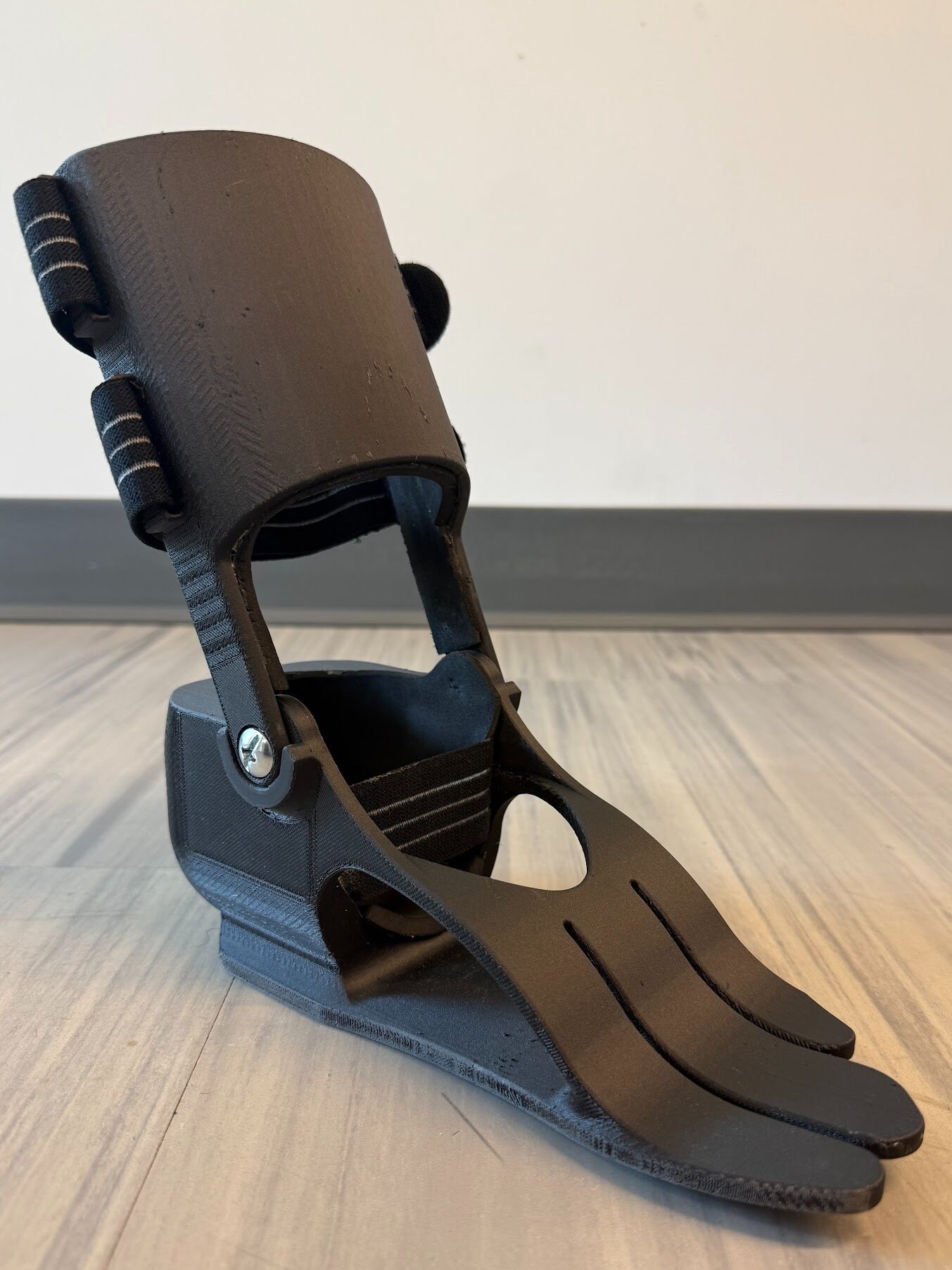
Chopart Prosthesis Final Model for SP II
The socket/baseplate structure and proximal brace was 3D printed in Onyx reinforced with continuous carbon fiber. The carbon fiber reinforcements in the socket/baseplate structure was placed strategically in the baseplate area and around the hinge areas, using a concentric printing pattern. The proximal brace was reinforced in the 45, 90, and 135 degrees directions.
Hardware components include zinc-plated steel binding barrels and bolts, bronze oil-embedded thrust bearings, and Loctite 243 threadlocker. Elastic straps were utilized to secure the proximal brace to the mid-shin area and the socket to the front of the residual limb to allow a secure fit. The prosthesis is able to fit comfortably within a 10.5-foot men’s shoe.
Walking Test Results
The subject performed a final walking test with the model by taking a few steps. During this test, the subject was able to safely walk in the device while wearing a standard 10.5 size shoe, utilizing external support for stability. While the basic mechanical functions of the device were validated, the session provided critical feedback for future iterations. The user reported significant tightness within the socket, and uncomfortable pressure/force in the shin area. At the current hard stop angle of 10 degrees dorsiflexion, the subject also expressed feelings of instability. These findings indicate that while the core mechanical goals were achieved, refining the socket geometry and reducing the dorsiflexion angle to 5 degrees will be necessary to improve the comfort and balance of the design. Adjustments must be made to increase the comfortability according to this test. The overall strength of the prosthesis must also be improved to pass all ISO 10328 standards.