
This timeline shows the progression of the STEP Chopart Prosthesis from it’s initial model back in the Fall 2025 to the latest version presented in Spring 2026
Fall 2025 Prosthesis Iterations. The following 4 models were the preliminary designs to choose for best ankle mobility and improved foot lever.
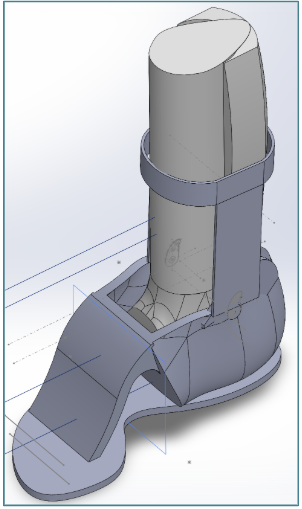
Hinge Joint Design
(SolidWorks, Waltham, MA)
The hinge design provided a free range of ankle motion. The socket was designed to limit the hinge’s motion for 20 degrees of dorsiflexion and 50 degrees of plantarflexion from a 90-degree angle
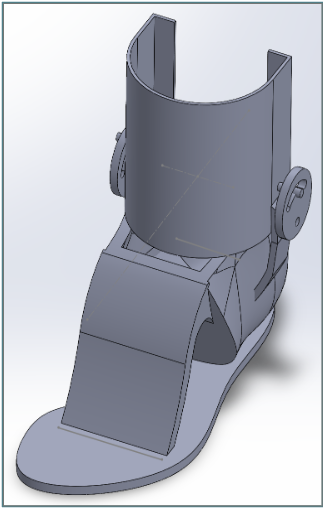
Slotted Hinge with Pins
(SolidWorks, Waltham, MA)
This design addressed the issue that was common with current Chopart AFOs with limited plantarflexion and dorsiflexion. The hinge makes for a controlled flexion point, where the pin would stop flexion at extreme points.
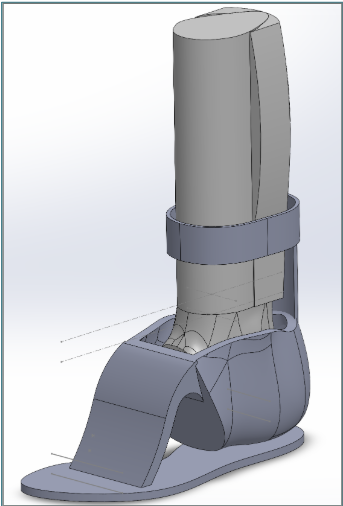
Exterior Leaf Springs
(SolidWorks, Waltham, MA)
The exterior leaf spring design incorporated the use of a leaf spring to store and release energy for propulsion when shifting from the heel strike to toe-off phases of the gait cycle, creating a spring-like motion.
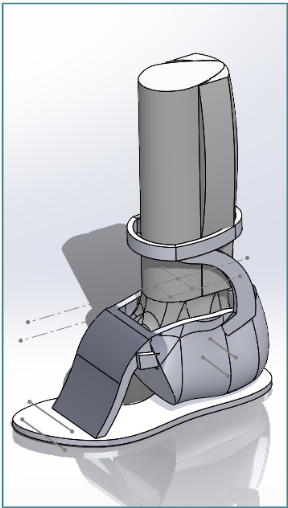
Lateral Leaf Springs
(SolidWorks, Waltham, MA)
The lateral leaf spring design shares the benefits of the exterior leaf spring design however gave more support laterally on each side. It was designed to be curved starting at the heel to store the energy from the heel strike.
SP I Final Design
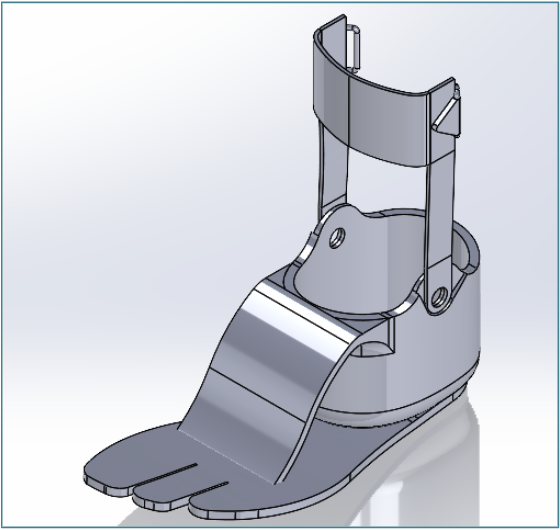
(SolidWorks, Waltham, MA)
Even though each of the previous designs had aspects that were beneficial, they lacked the stress distribution the prosthesis needed. The intention was to also prevent high stresses at the interior socket wall to prevent any damage or injury to the residual limb.
SP II Final Design
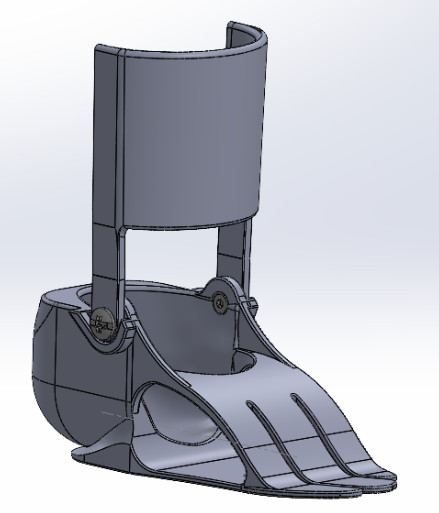
(SolidWorks, Waltham, MA)
After receiving feedback from the subject and testing prototypes, alterations were made to the SP I design. The front of the socket was removed for comfort, the interior wall size was tested for tolerancing, the hard stops at the hinge region were decreased to allow 10 degrees of dorsiflexion and 20 degrees of plantarflexion, and the proximal brace area touching the shin was increased to more effectively distribute the high pressures located at this area.